
After the CIR: What Is Supposed to Happen Next?

Updated: Sep 6
A source-grounded look at responsibility, routing, support, and performance after a member documents a trespass.
Reader Context — Status-CorrectedThis post addresses Assembly-specific processes, responsibilities, and support pathways for status-corrected Americans operating within the framework being studied.Readers outside that framework should not assume these Assembly-specific procedures apply to their circumstances.Evidence rule: Where the source does not clearly establish a responsibility, handoff, or next step, that gap remains identified rather than being filled by assumption. |
I have begun publishing Criminal Incident Reports, or CIRs, as part of the public record.
For me, that raises a practical question that matters just as much as making the record itself:
Once a member has documented a trespass and the CIR has been recorded, what are the different actors of the Assembly supposed to do next?
That is the question I am working to answer.
The CIR Starts the Record
Anna Von Reitz’s Template for Prosecution — Part 1 gives a clear starting point.
She writes that the work of the civilian government is to protect its people and their assets from illegal search, seizure, confiscation, attachment, arrest, detainment, and subjection under foreign law. She then directs people experiencing a trespass against themselves or their property to begin with their State Assembly, complete a Federation Criminal Incident Report, and have the State Recording Secretary record it.
In the particular process described in that article, the recorded CIR is then carried forward into later court process rather than being treated as an isolated document.
A later completed CIR example also shows a recorded incident being forwarded and served on additional actors. That supports treating the CIR as a continuity record—something that can travel with the matter as it develops.
So the CIR is not just a form to fill out and forget.
It is part of an ongoing process.
The question is what responsibilities come into play around it.
The Member Has a Part
The member’s first responsibility is to preserve what happened.
That means testimony, evidence, chronology, correspondence, court records, photographs, receipts, service records, and whatever other material belongs to the incident.
The course work developed so far keeps that part simple:
Something happens → the member preserves the facts and evidence → the record is created.
From there, the Assembly-side responsibilities begin to matter.
The State Recording Secretary Has a Clear Responsibility
This is one of the clearest responsibilities in the current source set.
Anna expressly instructs the member to have the State Recording Secretary record the CIR. She describes that recording as establishing an international record usable in later international court process.
So at minimum, the Recording Secretary’s role is not mysterious:
The CIR gets recorded and preserved as part of the continuing record.
What the current sources do not yet establish is that recording the CIR automatically alerts every other Assembly office or automatically creates a particular internal handoff. Study 5 specifically marks an automatic “recording triggers intervention” rule as not found.
That means recording is one responsibility.
The next responsibilities have to be identified separately.
The Litigation Committee Has a Member-Support Responsibility
This is where the source material becomes especially important.
The Litigation Committee or Litigation Subcommittee is described as working with Assembly members who have active litigation concerns.
The course research identifies this as an active member-support function.
The source material reviewed for Study 6 describes that work as helping members assert their position in relation to foreign courts and educating them to avoid entrapment.
That means the Litigation Committee is not merely a committee name on an organizational chart.
Where a member has an active litigation concern, there is a described support responsibility.
But some important practical questions remain open:
How does the member formally invoke that support?
Who receives the request?
Does the Litigation Committee create a written record of what it did?
Does it help prepare notices or testimony?
Does it route the member to another office when the matter moves beyond its function?
What happens when the member asks for support and receives no known response?
The existing study specifically preserves these as unresolved questions rather than pretending the sources already answer them.
The State Prosecutor Has a Specific Responsibility
Another source gives a more specific responsibility when particular court-related conditions are present.
Course synthesis: Where a person is mis-addressed, coerced, presumed upon, or has constitutional guarantees challenged or violated, the court-matters material directs the preparation of a complaint and Witnessed Testimony in Lieu of Affidavit for delivery to the Office of the State Prosecutor. |
The same course work identifies the State Prosecutor’s role as connected to defending constitutional guarantees.
That gives us a clearer responsibility:
When the stated court-related trigger exists, the State Prosecutor becomes part of the support and remedy process.
What remains less clear is how the member gets from the CIR or Litigation Committee stage into that office in every real-world case.
That handoff still needs better sourcing.
The Chairman/Speaker Has a Communication Responsibility
The Chairman/Speaker has a separate role.
The current source work identifies the Chairman as the spokesperson for the Assembly and the signer of the State-level Assembly notices described in About Notices for State Assemblies.
For this blog, the important point is practical:
When an Assembly-level outward notice is required, the Chairman/Speaker has a communication role.
The question I am still studying is not whether that office exists.
It is when, in the life of a member’s trespass matter, that responsibility is supposed to become active and what information or record reaches the Chairman to make that possible.
6th day of September, 2026 Update — Individual Member Trespasses and the Assembly’s Notice Role
A closer reading of Anna von Reitz’s About Notices for State Assemblies clarifies an important point in this study. The article expressly refers to trespasses involving “State Assemblies or their members.” That means individual member experiences are directly within the scope of the source. Anna then describes the resulting governmental communication as being sent by the Assembly, under the Assembly Seal, with the signature of the elected State Assembly Chairman/Speaker, as State-to-State-of-State correspondence. In simple terms:
What remains unresolved is the internal handoff: how the member’s CIR or supporting record moves from recording into the Speaker/Chairman’s notice process so that this Assembly response is actually performed. Course impact: This clarification affects both Study 5 and Study 6. The question is no longer whether individual member trespasses are contemplated by the Assembly notice framework; they are. The remaining question is how that record is routed into the proper Assembly action. |
The Coordinator Has a Federation-Liaison Responsibility
The Coordinator also has a distinct responsibility.
In About Notices for State Assemblies, Anna describes the Coordinator’s role in this context as informing the Federation about trespasses involving federal agencies having, or pretending to have, delegated authorities.
That is a meaningful responsibility.
It tells us that some trespasses are not supposed to remain only at the local or State Assembly level.
Where the described Federation-facing condition exists, there is a liaison function.
The practical questions are again about performance:
Who identifies that the condition has been reached?
Who sends the information to the Coordinator?
What record should show that the Coordinator received it?
What does the Coordinator transmit?
What response comes back?
What happens if no known response is received?
Those are exactly the kinds of handoff and continuity questions the course still needs to answer.
Other Assembly Actors May Have Responsibilities Too
One encounter can involve more than one Assembly function.
The current research identifies other possible actors, but their roles have to be connected to the actual facts rather than assumed from their titles.
For example, the Sheriffs Committee is described as working with Assembly County Sheriffs and helping them perform their duties, but the current source set does not establish that the committee automatically intervenes every time a member is stopped by a foreign county sheriff.
Likewise, the International Business Assembly has its own sphere of work, but the course research does not treat every problem involving an outside governmental actor as automatically belonging to the IBA.

The practical lesson is simple:
Different facts may engage different Assembly actors.
The important task is to know what each actor is supposed to do when their function is actually engaged.
Now Compare the Described Structure to What Has Actually Been Used
Taken together, this is a substantial list of Assembly functions: recording the incident, supporting members with active litigation concerns, defending constitutional guarantees, communicating outward on behalf of the Assembly, coordinating with the Federation when the circumstances call for it, and engaging other competent functions when their particular responsibilities fit the facts.
That raises an important performance question for Washington.
The newer Silver Bullet Committee appears to be taking over work that overlaps with the earlier Litigation Committee and member-support pathway described in the corpus. But before treating the newer process as a replacement, we need to establish something more basic:
Was the earlier pathway ever actually implemented and used here?
There is an important difference between a process that was used and failed and a process that was never meaningfully implemented, never routed to, or never given an opportunity to perform.

The record should distinguish:
FAILED AFTER USE
NOT IMPLEMENTED
NOT ROUTED / NOT ENGAGED
SUPERSEDED BEFORE PERFORMANCE WAS ESTABLISHED
UNKNOWN
That distinction also matters when discussion turns toward commercial or agricultural liens on the premise that other remedies “do not work.” Before that conclusion can be supported, there should first be a record showing which of the previously described measures were actually used, who performed them, what happened, and where the process failed.
Unresolved Washington performance question: Did this Assembly ever meaningfully implement the earlier Litigation/member-support pathway described in the corpus, or is the Silver Bullet Committee now replacing a pathway whose performance here was never actually established?
The Larger Question: Are All Four Pillars Actually Being Implemented?
Looking at the individual offices and committees raises a broader question.
A functioning Assembly is not just a collection of titles. It is supposed to operate through distinct pillars, each with its own responsibilities, functions, and limits. When a member experiences a documented trespass, the question should not be reduced to which single committee receives the complaint. The larger implementation question is whether the matter is being handled through the appropriate pillar functions at all.
For each of the four pillars, the same basic questions should be asked:
What responsibility does this pillar have?
What facts trigger that responsibility?
What action is it supposed to take?
What work product, decision, referral, notice, or handoff should result?
And how is that performance recorded?
General Assembly
What decisions, approvals, resolutions, votes, or instructions belong to the General Assembly before another function acts in the name of the Assembly?
What belongs to the people acting together, and what does not require a full Assembly decision?
Where does the record show that the General Assembly has actually exercised its part of the process?
International Business Assembly
When documented member problems reveal a recurring issue involving outside governmental actors, agencies, service providers, statutes, regulations, or delegated functions, what responsibility does the IBA have?
Does the IBA identify and classify the external problem, determine the proper governmental counterpart, prepare or recommend the appropriate communication, or route the matter elsewhere?
And when the problem involves repeated State-level trespasses, does the corpus actually direct the IBA toward the legislature, or toward another State-to-State-of-State recipient or process?
The important question is not merely, “How do we approach the legislature?”
It is:
“What does the corpus tell the IBA to do with this kind of documented problem, and who is the correct recipient of the resulting governmental communication?”
Jural Assembly and Judicial Functions
What fact-finding, court-support, prosecution, jury, or remedy functions are triggered by the documented matter?
Where do Litigation Committee support, the State Prosecutor, court-related testimony, or other judicial functions enter?
If those functions are described in the corpus, were they actually implemented and made available to members before newer structures were created to replace or bypass them?
Militia and Peacekeeping Functions
What protection, peacekeeping, readiness, or enforcement-support responsibilities, if any, are triggered by the facts?
What are the limits of that role?
When does a matter remain administrative, judicial, or diplomatic rather than becoming a peacekeeping matter?
The source should control that distinction rather than assumption or urgency.
The Continuity Question Across All Four Pillars
The final question is not only whether each pillar exists.
It is whether the matter can move through the Assembly without being dropped, duplicated, misrouted, or prematurely escalated.
A working system should be able to answer:
Which pillar is engaged first?
What does that pillar do?
What must be handed to the next function?
Who receives it?
What record proves that the handoff occurred?
What happens if the receiving function does not perform?
When does the matter properly move to another pillar or outward to a foreign governmental actor?
That creates a larger performance test for Washington:
Which of the four pillars were actually engaged in response to documented member trespasses, which were bypassed, which functions were never implemented, and which responsibilities may now be shifting into newer structures such as the Silver Bullet Committee?
Until those questions are answered, it is difficult to distinguish between a process that genuinely failed and a process that was never fully implemented.
What Does Performance Look Like?
A functioning process should leave a trail.
If a member submits a record or asks an Assembly actor for support, there should be some observable indication of what happened next.
But even here, the record has to be handled carefully.
The course currently distinguishes between:
a response being received;
a function being performed and communicated;
a function being performed but not communicated;
no response record being found;
the function never actually being engaged;
nonperformance;
and a situation where the record is simply insufficient to know.
That distinction is important. “No known response” does not automatically prove refusal.
But neither should the absence of visible follow-through be ignored.
If an Assembly office has a responsibility to support, route, communicate, defend, or follow a matter, then members should be able to identify what performance of that responsibility looks like.
That is one of the major questions this study is now pursuing.
A Recorded CIR Should Not Become a Dead-End Record
This is the part I am most interested in now.
The CIR process exists within a framework that Anna describes in terms of protecting the people and their assets.
The Litigation Committee is described as supporting members with active litigation concerns.
The State Prosecutor has a described responsibility when certain court-related harms occur.
The Chairman/Speaker has a role in outward Assembly notices.
The Coordinator has a Federation-liaison function when the relevant delegated-authority issue is present.
Those responsibilities exist in the source material.
What I am trying to understand is how they are supposed to work together in practice when one of the People brings forward a real trespass.
So What Is the CIR Supposed to Set in Motion?
The answer is becoming clearer, but it is not complete.
What we can presently say is:
The member preserves the facts, testimony, evidence, and continuing record.
The State Recording Secretary records the CIR.
The Litigation Committee has a described support role for members with active litigation concerns.
The State Prosecutor has a described role where the specific court-related conditions identified in the source are present.
The Chairman/Speaker has a role when State Assembly outward notices are involved.
The Coordinator has a Federation-facing liaison role where the described delegated-authority condition is involved.
Other Assembly functions may become relevant depending on the facts.
What we still need to trace more carefully are the handoffs:
Who receives the member after the CIR is recorded?
Who makes sure the member reaches the correct support function?
Who follows the matter?
Who tells the member what happened?
Who moves it onward when the next function becomes necessary?
And what happens when one of those responsibilities is not performed?
Those are not side questions.
They are the process.
Coming Soon: From the People to the Notice
These are among the questions being developed in my upcoming course:
From the People to the Notice
The course is not simply about writing a Notice.
It is about following what happens when one of the People experiences a real problem and turns to their Assembly for the support and governmental response the Assembly structure describes.
The course follows the matter from:
event → testimony and evidence → CIR and recording → member support → appropriate Assembly actors → notices or referrals → response → follow-up → next supported step
The current research already makes one thing clear:
The different Assembly actors are not interchangeable, and a functioning process requires more than creating records.
It requires people in the appropriate roles to actually perform their responsibilities.
A CIR should not simply disappear into a file.
A member should not have to guess endlessly about who is supposed to help.
And if the Assembly structure exists to protect the people and their assets, then one of the most practical questions we can ask is also one of the simplest:
When a member is trespassed, who is supposed to do what?
That is where this study is going.
Resource Library
Primary Corpus Sources
About Notices for State Assemblies
Template for Prosecution — Part 1
Update on Court Matters for State Nationals/Citizens
Recommended Basic Committee Structures
The Role of Coordinators
Related Study Materials
Study 5 — CIR / Recording
Study 6 — Governmental Support and Performance v1.2
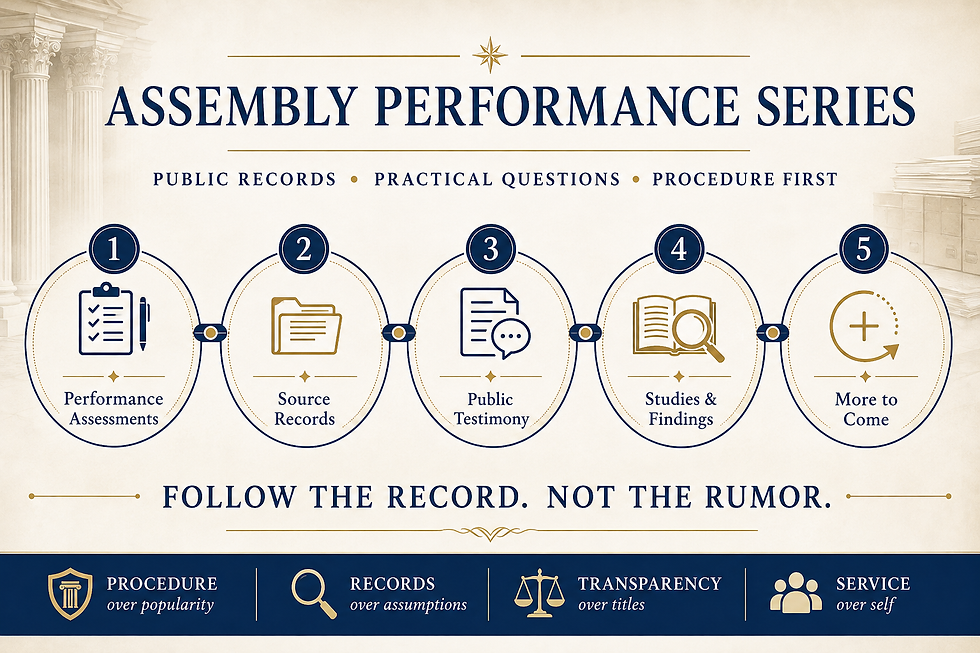
Assembly Performance series
Jural Handbook version-control note
Research Status
Current Jural Handbook comparison — Pending revised edition
Litigation Committee → Silver Bullet continuity — Under review
Body-level institutional injury pathway — Inference / under study
Comments