
What If There Really Is a Non-Commercial Path to Remedy?

What if the Assembly already has a governmental, non-commercial path to remedy?
Reader Context — Status-CorrectedThis post addresses Assembly-specific processes, responsibilities, and support pathways for status-corrected Americans operating within the framework being studied.Readers outside that framework should not assume these Assembly-specific procedures apply to their circumstances.Evidence rule: Where the source does not clearly establish a responsibility, handoff, or next step, that gap remains identified rather than being filled by assumption. |
For a long time, one of the hardest questions in Assembly work has been practical rather than theoretical:
What happens after the record is made?
A member can preserve testimony. A Criminal Incident Report can be completed and recorded. Notices can be drafted. Evidence can accumulate.
But if none of that leads to correction, what comes next?
One answer people sometimes reach for is commercial enforcement — liens, claims, or similar mechanisms. But the source material we have been studying raises another possibility:
What if the Assembly already has a governmental, non-commercial path to remedy — and the real problem is that the different parts of that path have not been consistently connected or allowed to perform?
That possibility deserves serious examination.
The Process Begins With the Individual Member
Anna von Reitz’s materials do not speak only about abstract injuries to an Assembly as a collective body.
In About Notices for State Assemblies, she expressly refers to trespasses against “State Assemblies or their members.” The wording matters because it brings the individual member’s experience directly into the notice framework. The same source says that State-level notices are sent by the Assembly under the Assembly Seal and the signature of the elected State Assembly Chairman, as communication “from the State to the State of State.”
That gives us an important source-supported distinction:
The member experiences and documents the trespass. The Assembly performs the governmental communication concerning the trespass against its member.
The concrete event may happen to one person: a stop, seizure, coercive court action, misaddressing, or another alleged trespass.
The Assembly body itself does not get pulled over or physically detained.
Its member does.
But the source describes an Assembly response to trouble involving those members.
That changes how the paper trail can be understood.
One Trespass Can Create More Than One Assembly Job
The earlier performance study identified several different Assembly functions that may become relevant depending on the facts.

The Recording Secretary records the incident. Litigation/member-support functions have been described for members with active litigation concerns.
The Chairman/Speaker performs the outward Assembly notice function. The Coordinator has a distinct Federation-facing function when federal agencies exercising or pretending to exercise delegated authority are involved. And another source gives a specific State Prosecutor route under stated court-related conditions.
Those offices are not interchangeable.
Nor does one document automatically invoke every one of them.
But the structure points toward something important:
The record is supposed to move.
A recorded CIR should not simply become a dead-end artifact.
What Happens When the Same Thing Keeps Happening?
Now imagine that this process operates repeatedly.
One member documents a trespass.
The Assembly responds through the appropriate governmental notice function.
Another member experiences substantially similar conduct.
Another record is created.
Another Assembly response follows.
And then another.
Each person still has an individual record and an individual injury.
But something else begins to develop at the same time:
an Assembly record.
The Assembly now has evidence that its members have repeatedly encountered the same or related conduct. It has records showing what happened, what governmental actors were notified, what correction was requested, what responses were received, and what conduct continued afterward.
This is where the possibility of an institutional matter begins.
The pathway work developed so far already recognizes that individual cases showing a recurring pattern may become a possible institutional issue for the proper Assembly body to examine. It also preserves the distinction between individual claims and a broader institutional record.
That bridge is still partly inference and proposed implementation, not a fully sourced procedural rule.
But it is a serious possibility.
The Notice Changes Character
This also changes how we might think about a later notice to a legislature, Governor, Secretary of State, agency, or other State-of-State counterpart.
The notice no longer has to begin as a long educational essay trying to convince the recipient that a problem theoretically exists.
Instead, it may eventually say, in substance:
Here are the documented incidents involving members of our Assembly. Here are the governmental notices generated in response. Here is proof of delivery. Here are the responses or documented nonresponses. Here is what continued after correction was requested. Here is the pattern now before the Assembly body.
That is a very different posture.
The weight does not come from sending an enormous volume of paper merely to create pressure.
It comes from actual events generating actual records and actual governmental responses.
If there are many trespasses, there may naturally be many records.
The volume is a consequence of the conduct.
And What If Correction Still Does Not Happen?
This is where the non-commercial remedy question becomes especially interesting.
Silence alone is not a crime.
A legislature failing to answer a notice does not automatically prove criminal conduct.
Our developing pathway has consistently preserved that boundary. It requires identifiable conduct, competent testimony and evidence, jurisdictional classification, and an appropriate complaint before prosecutorial or Jural consequences are considered.
But the the material does describe functions beyond mere notice.
The State Prosecutor materials used in the earlier study identify specific qualifying conditions. The study records the route where a person is mis-addressed, coerced, presumed upon, or has constitutional guarantees challenged or violated: a complaint and Witnessed Testimony in Lieu of Affidavit are prepared for delivery to the Office of the State Prosecutor.
That is not the same thing as:
notice ignored → prosecution.
It is closer to:
qualifying conduct→ competent complaint→ witnessed testimony and evidence→ proper jurisdiction→ State Prosecutor
And other Assembly material describes Oversight Committees investigating serious allegations of criminal behavior backed by credible evidence and making recommendations to the Sheriff’s Office, Continental or U.S. Marshals, or the General Assembly for further investigation and/or prosecution.
That is already a very different remedy architecture from a commercial lien.
So What Might a Non-Commercial Path Look Like?
At this stage, the developing pathway can be stated this way:
individual trespass → testimony/evidence → CIR and recording → appropriate Assembly governmental notice → documented response or continued conduct → repeated incidents create cumulative record → proper Assembly body examines the institutional issue → qualifying criminal conduct is separated from mere disagreement or silence → complaint and witnessed testimony move into the appropriate prosecutorial/Jural function → independent court, jury, sheriff, marshal, or other enforcement functions perform their own roles where supported
Some parts of that sequence are directly supported by the material.
Some are strong inferences from separate source-supported functions.
Some connecting procedures remain missing.
That distinction matters.
But even with those gaps, the larger question is now unavoidable:
Before concluding that commercial liens are necessary because other remedies “do not work,” have the Assembly’s own governmental notice, prosecution, Jural, court, and enforcement functions actually been connected, invoked, and allowed to perform?
That is a different question from whether a lien is available.
It asks whether we have fully tested our own governmental machinery first.
The Missing Middle May Be the Real Problem
There is another complication.
What if the individual CIRs were recorded, but the corresponding Speaker/Chairman notices were never sent?
What if the Coordinator was never informed when the Federation-facing trigger existed?
What if the prosecutor route was never used when its stated qualifiers were present?
Then a later Assembly body approaching a legislature does not possess the paper trail that would have existed had those functions been performed consistently.
That does not necessarily mean the pathway failed.
It may mean the pathway was not implemented.
The existing performance work already distinguishes:
failed after use,
not implemented,
not routed or engaged,
superseded before performance was established,
and unknown.
That distinction may become crucial.
A remedy cannot fairly be declared ineffective if the functions that were supposed to produce it were never actually put into motion.
A Necessary Jural Qualification
There is still a source-control issue on the court side.
Anna later stated that an older Jural Assembly Handbook contained errors and that a revised edition exists. Until that revised edition is located and compared, structural conclusions drawn from the older handbook should be treated as provisional research leads, not settled current instruction.
That does not require us to abandon the Jural question.
It means we keep our claims narrow until the current source can be verified.
Maybe the Real “Consequence” Is the Governmental Record Itself Becoming Actionable
A legislature may ignore an educational letter.
An agency may disregard an isolated complaint.
But an accumulated governmental record is something different.
If individual members repeatedly document qualifying conduct, if the Assembly repeatedly responds in its own governmental capacity, if responsible actors are repeatedly put on notice, and if the conduct continues, then the issue may eventually mature from a collection of individual incidents into an institutional matter supported by a substantial record.
At that point, the question may no longer be:
Will they read our notice?
It may become:
What does our own governmental process authorize us to do with the record we have already built?
That is the non-commercial path I am now looking for.
Not a shortcut.
Not automatic liability.
Not a commercial claim substituted for government.
A process in which the People document what happened, the Assembly performs its proper functions, the record accumulates, qualifying conduct moves into the appropriate prosecutorial or Jural function, and lawful consequences arise from the underlying conduct and competent governmental process.
Source discipline
Claims in this article are limited to what the located materials supports. Connections between separate functions are identified as inference where the corpus has not yet supplied the complete handoff. Proposed operating procedures remain proposals. Older Jural Assembly Handbook material remains provisional pending comparison with the revised edition.
Resource Library
Primary Source Materials
About Notices for State Assemblies
Template for Prosecution — Part 1
Update on Court Matters for State Nationals/Citizens
Recommended Basic Committee Structures
The Role of Coordinators
Related Study Materials
Study 5 — CIR / Recording
Study 6 — Governmental Support and Performance v1.2
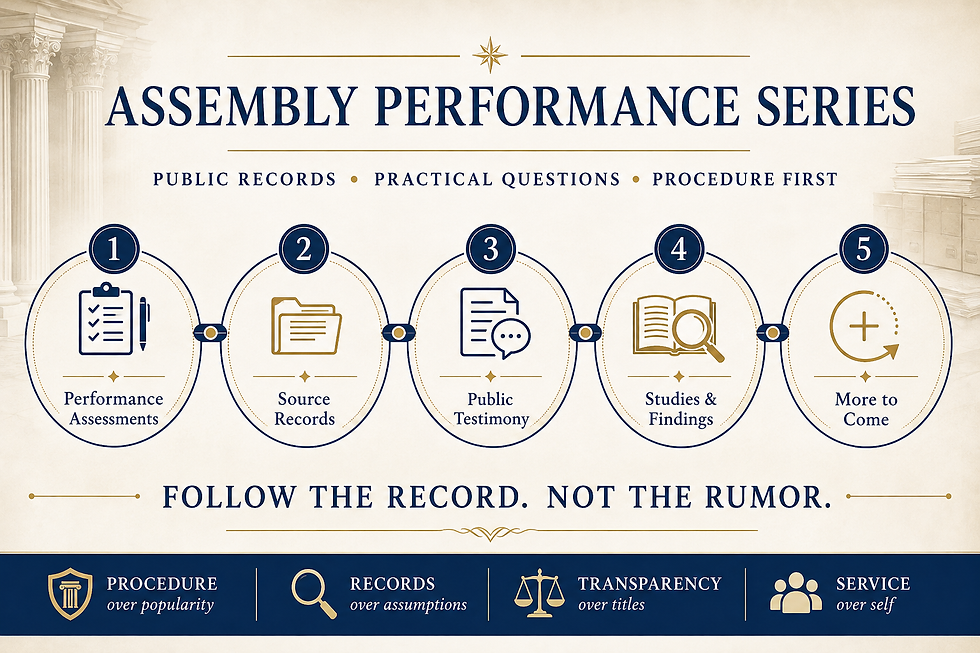
Assembly Performance series
Jural Handbook version-control note
Research Status
Current Jural Handbook comparison — Pending revised edition
Litigation Committee → Silver Bullet continuity — Under review
Body-level institutional injury pathway — Inference / under study

Comments